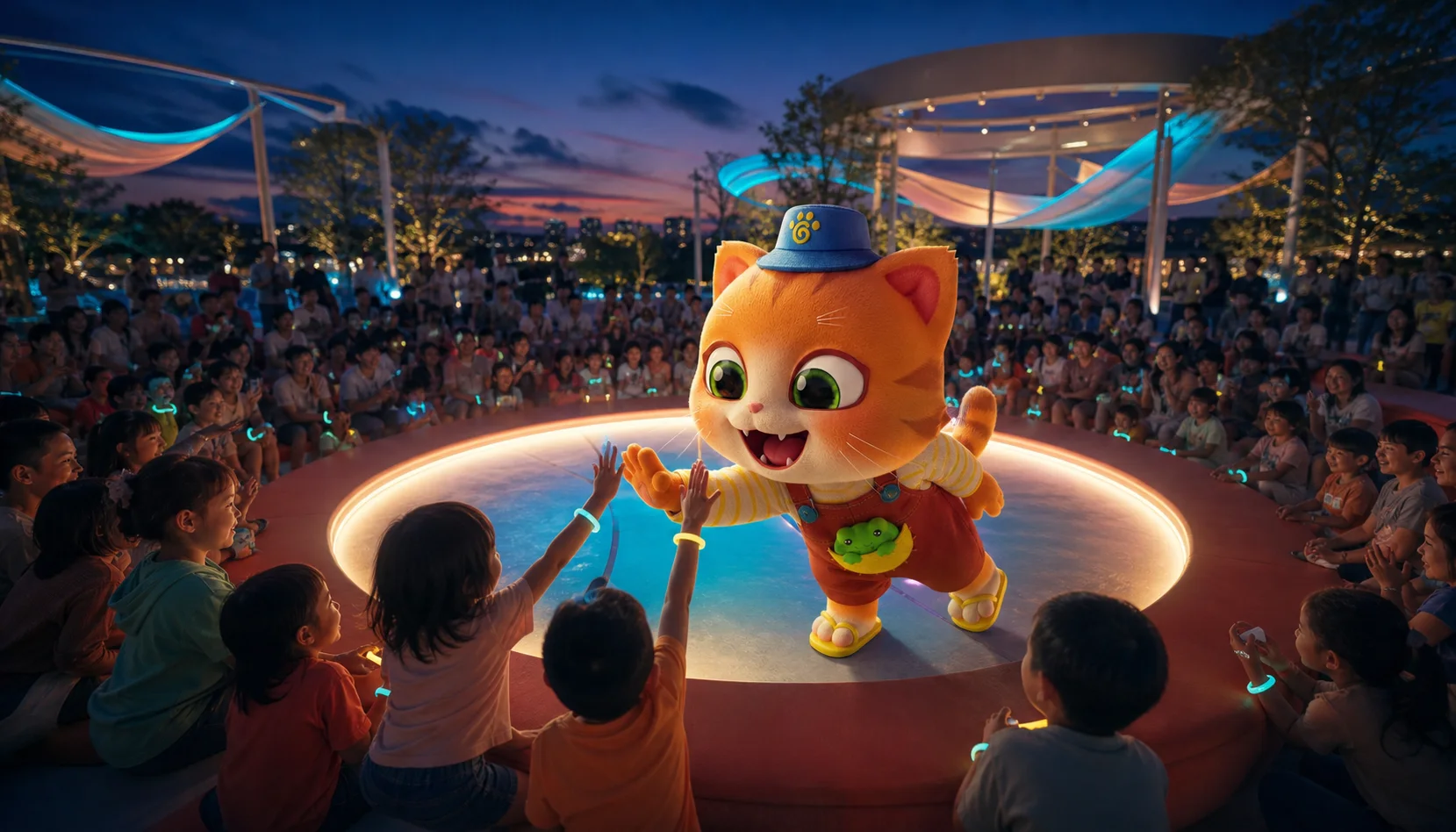
A character can be familiar, loved, and visually distinctive while still being limited to static artwork or pre-recorded scenes. A real-time digital character changes that relationship. It gives the character the ability to appear, perform, and respond while an audience is present.
That difference matters for any company that owns character intellectual property. Instead of treating the character as a campaign asset that appears only when new content is produced, the brand can develop a persistent digital representative: one identity that moves between social content, live streams, events, displays, and other audience moments.
NeoAvatar calls this shift real-time digital presence.
What makes a digital character real-time?
A real-time digital character is an animated character whose performance can be created and delivered as an interaction happens. Its expressions, body movement, speech, and responses are not limited to a single exported video.
This does not mean every appearance must be improvised. A strong character can combine planned storytelling with live performance. The important distinction is that its identity is ready to participate in the moment.
A real-time character can:
- greet an audience at an event;
- respond to a host or performer;
- appear on an LED wall or live-streaming layout;
- react to questions and audience input;
- present a product or story in its established personality;
- move from a physical venue to an online channel without becoming a different character.
The character remains recognizable. The experience around it becomes more immediate.
Static character, animated content, and live avatar
These formats are related, but they solve different communication needs.
A static character establishes recognition
Illustrations, key visuals, packaging, and campaign artwork are effective ways to make a character recognizable. They define shape, color, costume, and visual attitude. Their limitation is not quality; it is that they cannot respond.
Animated content builds a story world
Short-form animation gives the character timing, behavior, and narrative. It can establish how the character walks, celebrates, jokes, cooks, learns, or explores. This is the foundation of NeoAvatar Content: repeatable stories designed around a consistent digital personality.
A live avatar creates shared presence
A live avatar introduces the character into the same moment as the audience. When Oyen appears on a large screen and responds during a live event, children are not simply watching another episode. They are participating in an encounter.
That is the value of NeoAvatar Live. The character becomes part of the room.
The five layers of a convincing digital presence
Technology alone does not make a character feel alive. The audience experiences the result as one personality, even though that result depends on several connected layers.
1. Identity
The character needs a stable visual and behavioral identity. Silhouette, face, clothing, color, signature expressions, and movement language should all feel intentional. A technically impressive avatar that drifts away from the original design weakens the value of the IP.
2. Performance
Movement communicates personality before the character says anything. A curious mascot, a calm guide, and an energetic entertainer should not share the same rhythm. Performance turns a model into a recognizable individual.
3. Voice
Voice includes more than sound. Word choice, pace, humor, warmth, and the way a character handles unfamiliar questions all contribute to its identity. Consistency is especially important when the character appears across multiple channels.
4. Context
A useful character understands where it is appearing and what it is there to do. An event performance, educational segment, brand presentation, and social video each need a different mode while still belonging to the same personality.
5. Deployment
The experience must work in the place where the audience already is: a stage, exhibition, live stream, video call, LED display, or social platform. Real-time presence becomes valuable when it can leave the production environment and meet people.
Why owned character IP is a strong starting point
Companies often build awareness around a mascot, fictional spokesperson, or branded character, then use that character in disconnected campaigns. A real-time digital character creates continuity.
The company does not need to replace the original artwork or abandon existing stories. Instead, it can extend the character into new formats while retaining ownership and creative control.
This creates several practical advantages:
- Recognition compounds. Each appearance reinforces the same character rather than introducing a new temporary presenter.
- The brand controls the role. Personality, visual rules, and approved subjects can be defined around the IP.
- Content and live experiences connect. A story seen online can continue at an event, and an event moment can inspire new content.
- The character can grow over time. New expressions, outfits, environments, languages, and knowledge can be introduced without rebuilding the identity from zero.
The goal is not to make a mascot imitate a person. It is to make the character more capable of being itself.
Where real-time characters create value
The right use case begins with an audience moment, not a novelty feature.
At an event, a live character can welcome guests, react to a host, or lead a shared activity. In retail or hospitality, it can become a recognizable digital guide. In education, a character can turn explanation into a more approachable exchange. For entertainment and museums, it can connect a fictional world with a physical space.
Online, the same character can join a stream, present a recurring format, or respond to a community while maintaining its established look and behavior.
The most effective strategy is usually a connected one: content builds familiarity, then live presence rewards that familiarity with interaction.
How to prepare a character for real-time presence
Before production begins, align the creative and commercial foundations.
- Clarify ownership. Confirm the rights available for the character, visual assets, voice, and intended channels.
- Document the identity. Gather approved artwork, expressions, proportions, colors, personality notes, and examples of what feels out of character.
- Choose the first audience moment. Start with a clear experience such as a live event, recurring social format, or digital presentation.
- Define the character's boundaries. Decide what it knows, how it speaks, which topics it can address, and when a human should take over.
- Plan continuity. Consider how the character's live appearances and produced content can support one another.
A focused first use case produces a stronger character than a long list of disconnected features.
Real-time digital character FAQ
Is a real-time digital character the same as a VTuber?
They can share methods of live character performance, but the purpose can be broader. A NeoAvatar may become a digital mascot, presenter, influencer, or live character experience owned by a company or IP holder.
Does the character have to look human?
No. A real-time digital character can be a stylized animal, mascot, fantasy figure, or human-like personality. The important requirement is a coherent identity that can be expressed through movement, voice, and interaction.
Can one character appear in both videos and live events?
Yes. That continuity is one of the strongest reasons to build a real-time character system. The same identity can support produced stories through NeoAvatar Content and audience interaction through NeoAvatar Live.
Does live interaction remove creative control?
It should not. The character's personality, role, knowledge, visual rules, and response boundaries can be designed before deployment. Live presence works best when spontaneity operates inside a clear character framework.
From character asset to digital representative
The future of character IP is not only more animation. It is more presence.
When a character can tell stories, appear live, and respond without losing its identity, it becomes more than a visual asset. It becomes a digital representative that audiences can recognize across moments and channels.